Traditions
5 October 2026
How to Stay Safe During Hunting Season in France: A Local Hunter’s Guide
A Provence hunter explains battues, warning signs, dog safety and practical ways to share the countryside during hunting season.
Read more →
13 March 2026
In Provence, the hunt is a team sport, a tradition, and a way of life. A hunter of Les Alpilles on wild boar, the battue, and why none of it happens without trust.
La Chasse · Les Alpilles
I grew up hunting. I am not going to apologise for it. Mankind grew stronger and smarter because we ate meat - and the hunt is as old as humanity itself.
My introduction to hunting came early, in South Africa, where the bush teaches you patience, respect for the animal, and a sharp awareness of everything around you. But hunting in France - and in Provence in particular - is something else entirely. It is, first and foremost, a team sport.
Forget the solitary figure in a tree stand or hunter stalking in the bush. Here, the hunt is a collective act, woven into the social fabric of rural life, governed by strict rules, ancient customs, and a great deal of good-natured argument over coffee before dawn.
In Provence, our main quarry is the sanglier - the wild boar. Do not underestimate it. These are canny, intelligent animals, with an acute sense of smell that puts most hunting dogs to shame. They are also, when their numbers go unchecked, genuinely destructive. A surpopulation in any area can have devastating consequences for farmers and landowners: rooted-up vineyards, ravaged olive groves, ruined pasture.
The boar is not a passive participant in this arrangement. It learns, adapts, and frequently wins. We hunt in the vast, rocky garrigue of Les Alpilles - a landscape of limestone ridges, dense scrub oak, and deep valleys that is as much the boar's home as ours. The distances between hunters on their posts can stretch to 500 metres or more. Shots are not guaranteed. The animals escape, often. This is as it should be.
The boar never gets shot on the road. Oh no - it gets shot down in the valleys. The terrain is always against you.

Every hunt has its hierarchy and its roles, as fixed and functional as any well-run operation. At the top sits le chef de battue - the Hunt Boss - who knows the ground, reads the signs, and assigns positions before anyone sets foot in the field. His word is final.
The hunters divide into two groups. Postiers are the shooters: they walk to assigned positions - their posts - chosen by le chef de battue and wait in silence, reading the wind and the light. Piqueurs, the drivers, move through the hunting area with dogs, pushing boar from their daytime shelters and driving them toward the waiting postiers.
The whole area is well-signalled. Safety is non-negotiable - it is not a suggestion or an afterthought, but the first order of business at every briefing. We do everything in our power to run a safe hunt. This is not sport shooting in a gallery. It demands discipline, awareness, and trust between every person in the field.
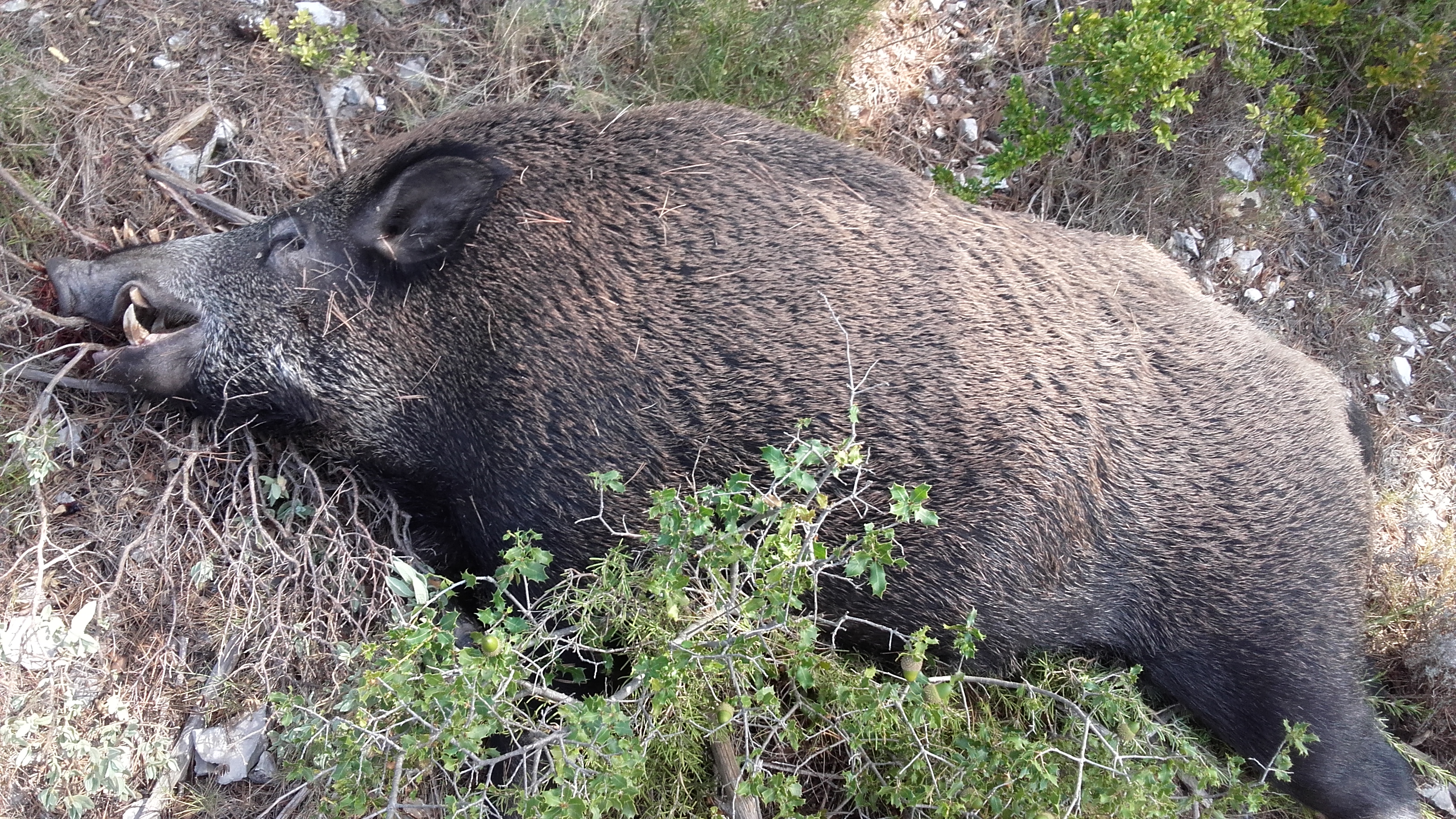
When a boar is taken, the work is only half done. A mature sanglier is a heavy, solid animal, and it will never oblige you by dropping somewhere convenient. The terrain ensures that. You attach a rope to the animal's head and you drag - through the maquis, through the scrub, up the valley walls. In the old days, donkeys did this work. Now, we are the donkeys.
There is something honest about it. The effort of recovery is part of the contract: if you harvest an animal, you do not leave it where it fell.
The hunting club is where the day ends and the real Provençal ritual begins. The boars are emptied and skinned with practiced hands, and then the meat is distributed - among the hunters, the landowners, friends, and neighbours. Nothing is wasted. Nothing is hoarded.
Wild boar meat is something to be proud of. It is dark, rich, and full of character - the taste of a free animal that ate acorns and roots in the garrigue. In Provençal kitchens it becomes civet, daube, terrines, and ragouts. It ends up in the slow-cooked, wine-braised dishes that belong to this landscape as much as lavender and thyme.
The meat is treasured. It passes through many hands before it reaches the table - and every one of those hands earned it.
Les Alpilles, Provence · La Chasse
🐸 Marcel says:
Never wear blue while boar hunting in the garrigue. The sanglier cannot see red, but blue stands out. Trust the old hunters - they did not survive this long by accident.
Loading comments...
Get new articles from Provence delivered to your inbox.
5 October 2026
A Provence hunter explains battues, warning signs, dog safety and practical ways to share the countryside during hunting season.
Read more →
30 June 2026
A 5:40am start, a field stolen by a private photoshoot, a melting sorbet incident, and the afternoon Provence finally decided to smile on us.
Read more →
22 May 2026
Getting four semi-conscious family members into a car before sunrise, a daughter who became a tourist attraction, and the lavender crème brûlée I am still trying to recreate.
Read more →